A little while ago, I was referred a question from the Dove team concerning pitch standards for bells. Part of the question was “I suspect that church tower bells stated to be in the key of F sharp are actually in the key of G at baroque pitch. For example, Yealmpton. If we name the bells by taking the note of A at the modern pitch of 440Hz then the tenor is F sharp, but if we name the bells by taking the note of A at baroque pitch of 415Hz, then the bells are in the much more sensible key of G.” Yealmpton are a peal of six dating from 1779, in the key of F# (tenor nominal 733Hz). Details of the bells are given in Towers and Bells of Devon, Volume Two, page 448.
In fact at the time the original six at Yealmpton were cast, bells in the UK were not in general cast or tuned to a specific pitch standard. To demonstrate this I investigated 9,945 UK bells in the UK for which I had the casting date and nominal frequency.
George Elphick covers pitch standards in his book ‘The Craft of the Bellfounder’. On page 98 he explains that pitch standards have changed considerably over the centuries and gives examples of Philharmonic pitch which was A = 424Hz in 1813 but rose gradually to A = 455Hz by 1874. There is a long paper by Alexander Ellis given as an appendix to Helmholtz’s On the Sensations of Tone giving frequencies for A over the centuries from 384Hz to 560Hz. George Elphick gives examples of bells for almost every frequency between 880Hz and 932Hz, i.e. at every point in the semitone between A and A#. He then goes on to say “Even as late as the end of the 19th century some founders used to pick out the bell with the flattest note in the ring, file up a set of tuning forks to suit its nominal and tune the others to it”. As a result the frequency of A in such a ring can be random – whatever came out of the mould.
To illustrate this, I have taken the 9,000+ bell recordings and calculated for each one what frequency for A would be appropriate. For example, if a bell is note C, I have taken its nominal frequency down an equal-tempered minor third to get an equivalent frequency for A. I also collapsed everything into the octave A=432Hz to A#=457.7Hz. I then counted the number of bells in each 5-cent band. A cent is 1/100 of a semitone, so this gives 20 divisions of the semitone.
Here is a plot of 5,221 bells with dates between 1050 and 1895. The date of 1895 was chosen because this was the point in time just before Taylors perfected their new tuning methods – they were the first UK founder to do this.
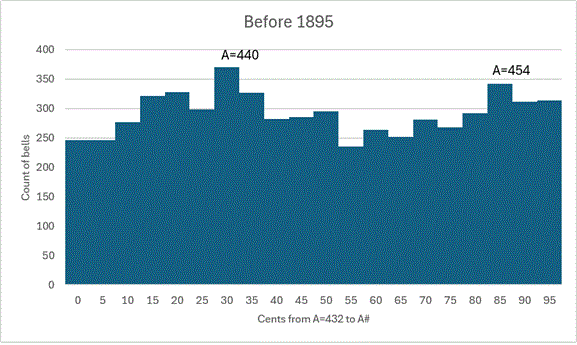
The plot is almost flat, i.e. there is no common pitch standard in use. There are slight peaks at A=440Hz and A=454Hz, more detailed plots for particular date ranges and founders might explain these.
The Taylor bellfoundry and their predecessors did not use note names for bells prior to the 1890s, they used a system of roman numerals. Chris Pickford wrote an article about this in RW 5954 (6 June 2025) page 512. The system was in use from the mid 18th century onwards. 0 denoted top C, XII was middle C and XXIV was bottom C. So throughout this period they were not using note names at all.
I have not plotted data for the period 1895 to 1925 because it is quite confusing – Taylors were using their new tuning methods, and Whitechapel and Warners the old ones. By 1925, Warners had stopped casting and Whitechapel had adopted the new tuning methods. The plot for 2,939 bells from 1925 to date is as follows:
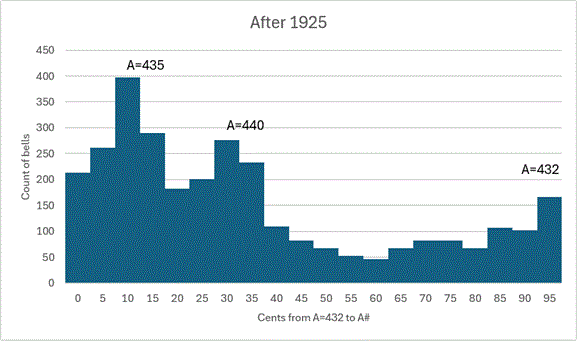
There are three distinct peaks at A=432 (both the start and the end of the plot, as it cycles round), A=435 and A=440. Tuning is generally done with an accuracy of +-5 or +-10 cents and this can be seen in the width of the peaks. There are some bells at other points in the scale between A and A#, these will be bells cast to match existing peals, single bells not tuned to a standard, and the trebles of stretched peals (where the trebles are tuned sharp to make them sound brighter).
For Gillett & Johston bells cast in the 20th century, the notes are given in the tuning books as well as the frequencies and the records make it quite clear that pitch standards A=432 or A=435 were used. Here is a example tuning book record (the bass bell in the carillon at Wellesley, Massachsetts, but UK bells have an identical format):
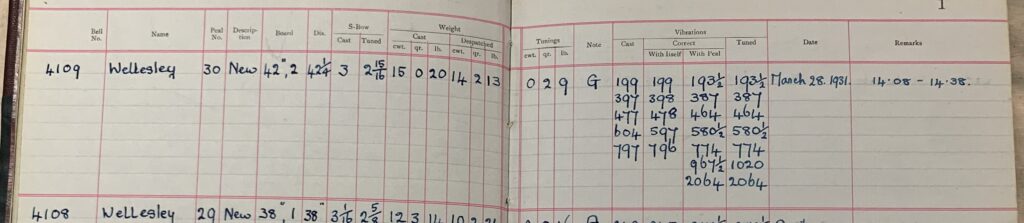
The note of the bell is given as G, and the nominal frequency is 774Hz. This corresponds to A=435Hz.
References
Elphick G, The Craft of the Bellfounder, Phillimore 1988
Helmholtz H, On the Sensations of Tone (reprint), Dover Publications 1954
Scott J, Mack F, Clarke J, Towers and Bells of Devon, The Mint Press, 2007